Worlds of Stone: 11/08/2011

As part of the current show (Worlds of Stone) at Pacific Science Center we’re updating the images we show from NASA’s MESSENGER and Dawn missions on a weekly basis. I’ll try to show them to you the week after we use the in the planetarium.

Dawn
Vesta

NASA Caption

Released November 7, 2011

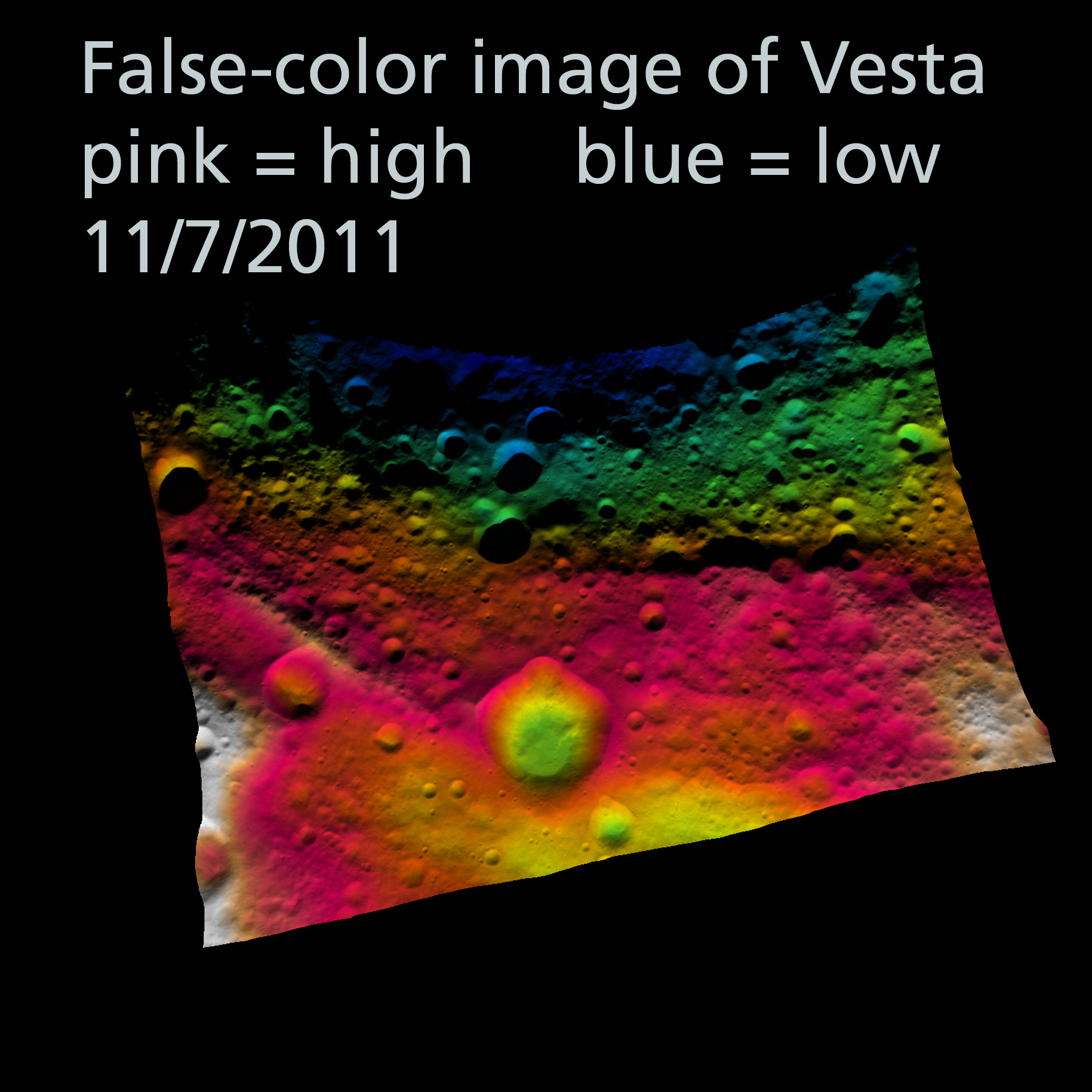
PASADENA, Calif. — These Dawn FC (framing camera) images show part of Vesta’s equatorial region, which contains a prominent, deep impact crater (lower center of image) and large troughs (linear depressions). The various colors correspond to the height of the area that they color. For example, the white areas in the bottom corners of the image are the highest areas and the blue areas along the top of the image are the lowest. The prominent impact crater is set into a topographically high area defined by the red and white color-coding. Above this area there are a number of deep troughs represented by green and blue color-coding. A conspicuous trough on the left, which looks like it could be quite deep in the albedo image, is shown by the color-coding in the topography image to be only a little shallower than the area surrounding it.
Image Credit: NASA/ JPL-Caltech/ UCLA/ MPS/ DLR/ IDA

Alice Says:

This is a standard terrain image with rainbow colors corresponding to elevation. Pink and white are high elevations, blue and green are low. There’s a weirdness in this one though – the colors go in this order: blue, green, yellow, orange, pink, brown, white. Orange and brown look almost the same.
My favorite feature here is the line running up to the left from the big crater in the middle. Due to the weirdness with the scale, I can’t tell if this is a ridge or a valley. What do you think? I have an e-mail out to JPL.

MESSENGER
Mercury, or a puddle?

NASA Caption

Released November 8, 2011

Date acquired: October 31, 2011

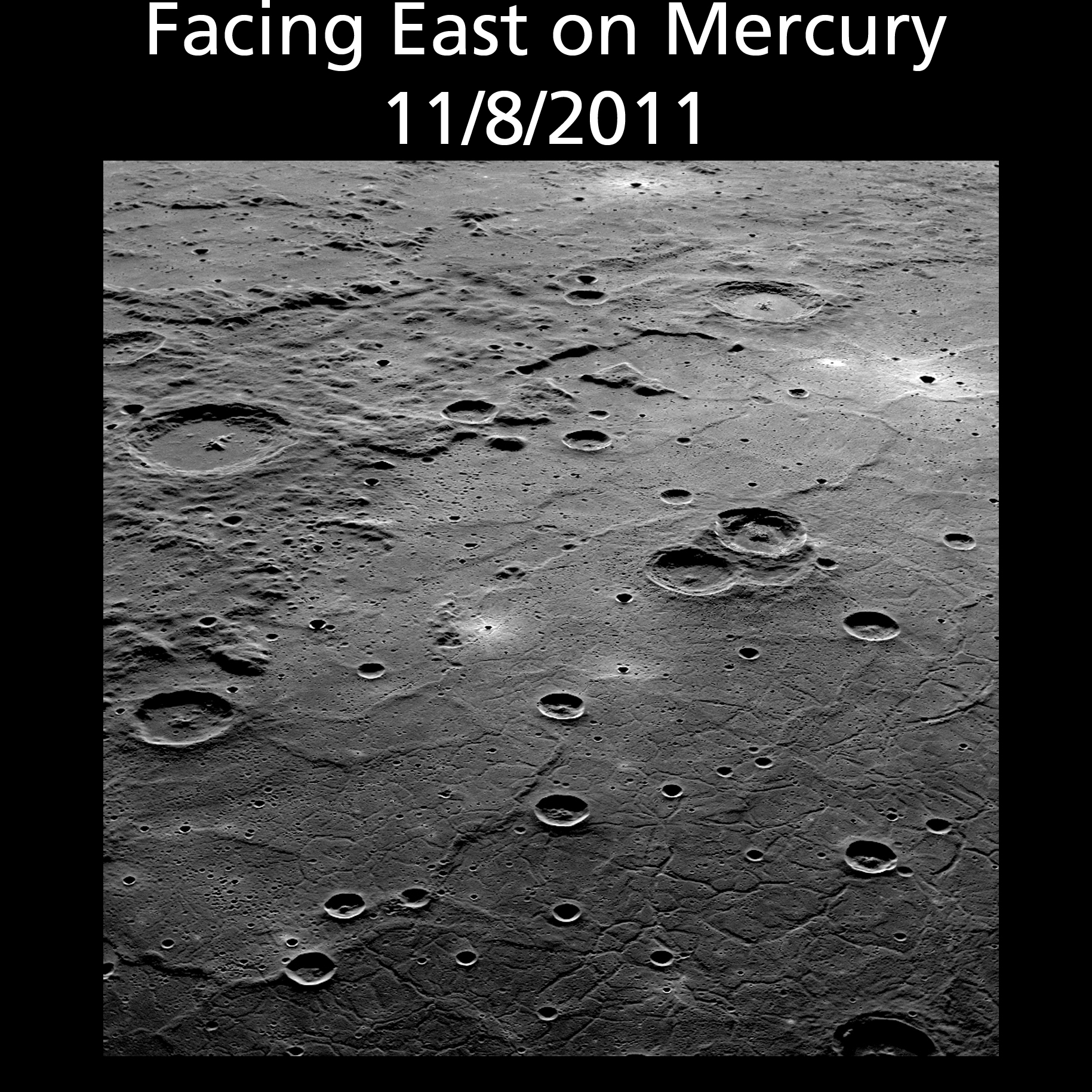
Of Interest: This eastward-looking image shows a wider view of the beautiful unnamed crater highlighted in yesterday’s featured image (center). The complicated folds and fractures that deform the once smooth floor of the Caloris basin can also be seen.
This image was acquired as a high-resolution targeted observation. Targeted observations are images of a small area on Mercury’s surface at resolutions much higher than the base maps. It is not possible to cover all of Mercury’s surface at this high resolution during MESSENGER’s one-year mission, but several areas of high scientific interest are generally imaged in this mode each week.

Credit: NASA/Johns Hopkins University Applied Physics Laboratory/Carnegie Institution of Washington

Alice Says:

If this image doesn’t take your breath away I can’t help you. Those craters look like raindrops in a puddle to me. This picture is so beautiful. Mercury looks like a PLANET here, not just a desolate collection of black-and-white photos. Of note: the bright areas are not highlights, they are crater rays – new dirt (“regolith”) kicked up by recent impacts.

Want More?

Worlds of Stone at Pacific Science Center

MESSENGER

Dawn

~ A l i c e !

Worlds of Stone, Worlds Unknown: NASA Investigates Mercury and the Asteroid Belt

We opened a new show in the Willard Smith Planetarium at Pacific Science Center. It’s all about NASA’s current missions in the inner solar system: MESSENGER to Mercury and Dawn to Vesta and Ceres.

As part of that show we’re updating the images we show from MESSENGER and Dawn on a weekly basis. I’ll try to show them to you the week after we use the in the planetarium.

Dawn

Boulders on Vesta Image Credit: NASA/ JPL-Caltech/ UCLA/ MPS/ DLR/ IDA

NASA Caption

Released October 12, 2011

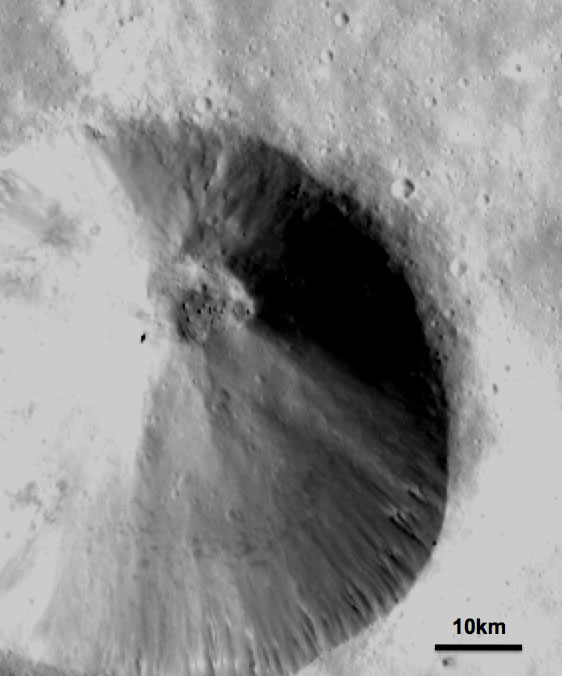
PASADENA, Calif. — This detail of a Dawn FC (framing camera) image shows a fresh scarp rimmed crater with many boulders on the crater floor. These boulders have diameters of 100-200m, which is roughly the size of many asteroids! Also evident in this image are linear mass movement features, which originate from the rim of the crater (bottom of image) and are due to material slumping towards the center of the crater. There are also many smaller, and presumably younger, impact craters on the walls of this crater.

NASA’s Dawn spacecraft obtained this image with its framing camera on September 20th 2011.

Alice Says

Let me unpack what NASA said for you:

  • “Fresh scarp rimmed crater “ – This crater is new, and it has a sharp edge, like a cliff (a scarp).
  • “Boulders on the crater floor. These boulders have diameters of 100-200m,” – That’s those tiny black dots in the middle there.
  • “Linear mass movement features” – Dirt moved. It moved in a straight line. The lines you see that go from the edge of the crater in towards the middle are these “linear features.” And technically I shouldn’t call it dirt. Regolith is better, but dirt gives you the right idea.
  • “Due to material slumping towards the center of the crater.” – slumping is like sliding. Imagine yourself sitting against a wall. You sit straight at first and then get tired so you scootch down a little, and maybe lean over on your elbow. Slumping is dirt doing the same thing, it’s just … slumped. It’s different that sliding because when you slide you end up all in a completely different place. Slumping you just compact in place, maybe spreading out a little at the bottom.
  • “Presumably younger” – when one crater is on top of another you can assume the crater on top is younger.

The boulders (dots) are my favorite part of this image.

MESSENGER

Mercury in Limb-O Credit: NASA/Johns Hopkins University Applied Physics Laboratory/Carnegie Institution of Washington

NASA Caption

Date acquired: September 19, 2011
Instrument: Wide Angle Camera (WAC) of the Mercury Dual Imaging System (MDIS)
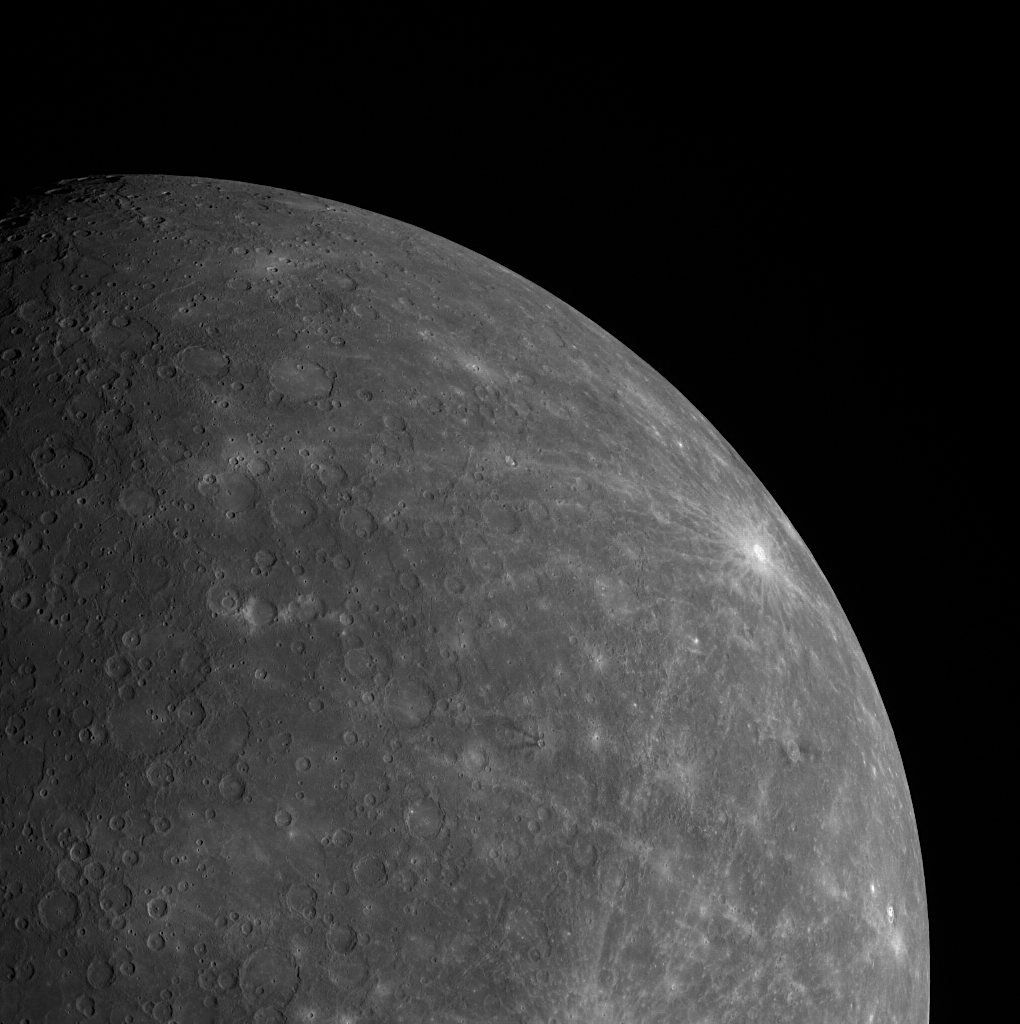
Of Interest: This image provides us with a beautiful view of a portion of Mercury’s southern hemisphere. The bright rayed crater near the limb is Debussy.. Also visible, near the center of the image, is Matabei, a small crater distinguishable by its unique dark rays.
These limb images provide information about Mercury’s shape.

Alice Says

I love bright craters – they’re bright because they’re new, not because their composition is different. So rocks are made of minerals, and minerals are usually crystals: they have a lattice of atoms very perfectly aligned. If you just leave a crystal out on a planet it gets scratched up, banged around and the surface gets marred or weathered. If you crack that crystal open, it cracks (cleaves) along those perfect lattice boundaries, between atoms, exposing a new surface. This surface is perfectly flat –flat at the molecular level!! – and therefore reflective like a mirror. This is a cleavage plane. When you smack a meteorite into a planet, you kick up a bunch of rocks and minerals, cracking them all open along those cleavage planes. These fall back down to the planet, reflective, pretty, and unmarred – which looks from space like a bright white crater and rays.

Want More?

Worlds of Stone at Pacific Science Center

MESSENGER

Dawn

~ A l i c e !

July-August 2010

July-August 2010 Starmap

Notable Sky Objects

Here’s a good link for getting rise/set data, and figuring out where to look for planets, comets, and the like: http://www.heavens-above.com/ (don’t forget to put in your location, the link I’ve given you assumes Seattle!).

JUPITER

Although it is not marked on the map, Jupiter rises just after midnight and will be visible in the early morning in the constellation Pisces (beside Pegasus).

VENUS and MARS and SATURN

After sunset watch above the Western horizon as it begins to get dark. You’ll see Venus, Regulus (bright star in Leo) Mars, and Saturn in that order, reading from right to left, making a nice long line across the sky. Venus has been beautiful the times I’ve seen it this month … that is, when the clouds cooperate and part for decent sky viewing. These planets will be visible until just about midnight, setting one by one until then.

COMET MCNAUGHT

As I’ve mentioned before this summer’s Comet McNaught is not the same as the Comet McNaught from a few years ago. Mr. McNaught is prolific in his comet discoveries.  To make sure you’re finding the right information, search for C/2009 R1 McNaught.

McNaught is currently in Gemini, passing close to the Sun which means we can’t see it. In a few weeks it will have passed its closest point to the Sun and will begin to move farther away, passing into our evening sky. Follow the progress at either of these links:

Sky and Telescope

Comet McNaught

EVENTS

July 23- August 22 (peak August 12) – Perseid Meteor Shower, best viewed after midnight, looking towards the constellation Perseus.

New Constellations

Quick note to long-time followers of AstroInfo. The section below is a straight copy-and-paste job from last July-August. The constellations don’t change from year to year, and we’ve got some new people this year who haven’t gotten the information below. Hey, perhaps you need a quick refresher too, after all, it has been a whole year. In any case, if you prefer to stop reading here I will not be offended.

AQUILA – The Eagle

SCIENCE: Altair is the BEST star in the whole sky (because I’m named after it).
MYTH: Tanabata: there are versions of this myth all over Asia, all slightly different, but all telling the same basic story. This is one of the Japanese versions. Kengyuu (Altair) is a cowherder boy and he is in love with Orihime (Vega) the weaver princess. They are so in love that they forget to do their chores, and the Emperor decides to punish them. He places them in the sky on opposite sides of Amanogawa, the River of Heaven (the Milky Way) so they cannot meet. The magpies take pity on them, and one day out of the year, on the seventh day of the seventh lunar month (August 26th, 2009), they build a bridge over the Milky Way so the lovers can be together. Unfortunately, if it is raining or cloudy, the magpies are not able to build the bridge.

ANDROMEDA – The Princess

SCIENCE: M31- The Andromeda Galaxy is visible to the naked eye, and better through a telescope.
MYTH: Saudi Arabians called Andromeda “the sea lion”. To the Phoenicians, the whole part of the sky where Andromeda is seen as a threshing floor, and the constellation is a grain thresher working

PERSEUS – Perseus

SCIENCE: The Perseid Meteor shower appears to radiate out of the constellation Perseus. The point meteors all appear to originate is called the “radiant.”
MYTH: For the ancient Chinese, the right side of the constellation Perseus is the Mausoleum. The star just inside the right-hand curl is Jishi – the Heap of Corpses.

PEGASUS – The Flying Horse

SCIENCE: The star at the tip of the horse’s head is called Enif, which means “nose.”
MYTH: The two northernmost stars in the Great Square of Pegasus (α And, and γ Peg: the star attached to Andromeda, and the star next to it that is part of the horse’s back) are the “Encampment” in Chinese mythology. There are three pairs of stars scattered near this asterism which are Ligong or “Resting Places” for the Emperor.

CAPRICORNUS – The Sea Goat

SCIENCE: Jupiter is right beside Capricornus this month.
MYTH: Part of Capricornus along with parts of Pisces and Aquarius make the “Line of Ramparts” in ancient Chinese mythology – a line of fortresses built by the celestial army. Since I can’t read Chinese, I can’t tell you exactly which stars these are, but check the Chinese Starmap.

“Tiny” Guys

Going for the Gold? Here’re this month’s itty-bittys.
CANES VENATICI – The Hunting Dogs
COMA BERENICES – Berenice’s Hair
SERPENS – The Serpent
LIBRA – The Scales
SCUTUM – The Shield
VULPECULA – The Fox
SAGGITA – The Arrow
EQUULEUS – The Horse
LACERTA – The Lizard
TRIANGULUM – The Triangle
LEO MINOR – The Small Lion (Between the Big Dipper and Leo)
CAMELOPARDALIS– The Giraffe
LYNX – The Lynx

Returning Constellations

DELPHINUS – The Dolphin
LYRA – The Lyre
CYGNUS – The Swan
SCORPIUS – The Scorpion
BOÖTES – The Herdsman
HERCULES – Hercules
CORONA BOREALIS – The Northern Crown
CEPHEUS – King Cepheus
DRACO – The Dragon
URSA MAJOR – The Great Bear
URSA MINOR – The Little Bear
CASSIOPEIA – The Queen

Where’d I Get My Info?

My memory, and Zeta Strickland
CHAN Ki-hung, Chinese Ancient Starmap, 2007

~ A l i c e !

Soil on Mars Honors Around the Americas

Happy Homecoming Ocean Watch, you now have a soil on Mars named after you. That’s right. A little patch of dirt* on Mars is now named “Ocean Watch.”

Wait, what’s Ocean Watch?

Pacific Science Center and Sailors for the Sea have just completed Around the Americas: a science outreach project to sail all the way around both North and South America (including through the Nortwest Passage). The boat they sailed was called Ocean Watch, and they did all kinds of fun science and activities with people at every port of call.

Mission:

Around the Americas is a 25,000 mile sailing circumnavigation of the American continents with the mission of inspiring, educating, and engaging citizens of the Americas to protect our fragile oceans.

Back when I was a kid the Northwest Passage didn’t exist, so this would have been impossible, and now not only is it possible, but my friend Zeta sailed through it. This wasn’t that long ago either … the ice really is melting.

Ocean Watch arrived back in Seattle today (June 17, 2010).

What does that have to do with Mars?

Nothing. But Dr. Amy Knudson from the Planetary Science Institute was volunteering with Pacific Science Center during the exhibit Facing Mars, and she works with the Mars Exploration Rovers doing soil analysis among other things. She was asking if we had recommendations for naming little things on Mars. The names had to be nautical, so I told her about Around the Americas and Ocean Watch. A few weeks later she returned, telling us that she’d proposed the name for one of the patches of soil she was analyzing and it had been accepted!

She’s just sent me some photos of Ocean Watch on Mars as taken by Opportunity (also known as Mars Exploration Rover B). She is continuing to name other soils and rocks after Around the Americas’ ports of call.

Show Me the Dirt*!

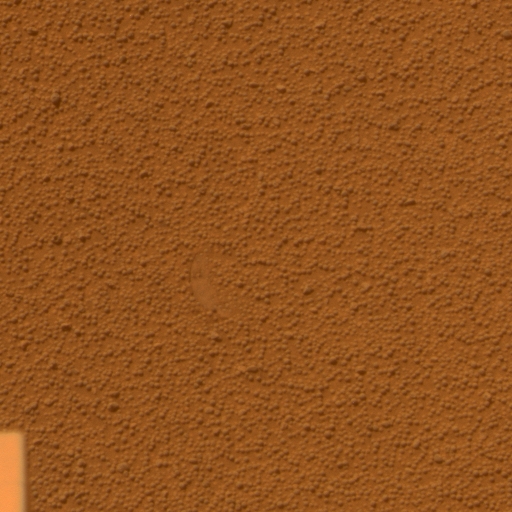
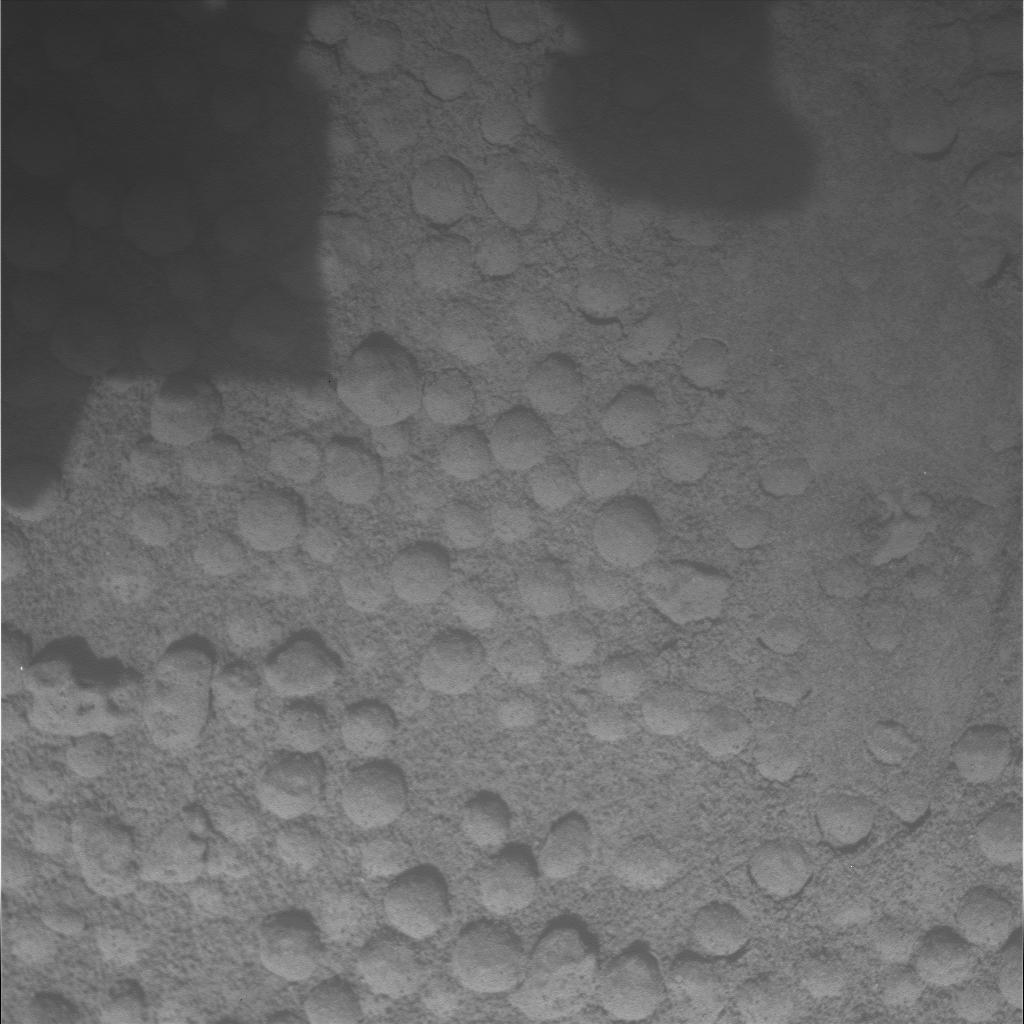
Ocean Watch (a soil on Mars) - field of view approximately 1/2 meter by 1/2 meter.
Photo credit: D. Savransky and J. Bell (Cornell) / JPL / NASA

Opportunity took this picture on Sol 2225 (martian day 2225) with its panoramic camera. This image is approximately true color, and shows a small impression where Opportunity’s instrument rested during the soil analysis.

Nothing has been released about the analysis of this soil yet – so your best guess about that texture is just great. Be the scientist – what do you think those “bubbles” are? Are they depressions or spheres? Are they hard? Soft? Are they just shapes in the sand that are easily disrupted or are they harder? Look at how they are different when they’ve been pressed by the instrument. Does that help you determine what they’re like? What might have caused them?

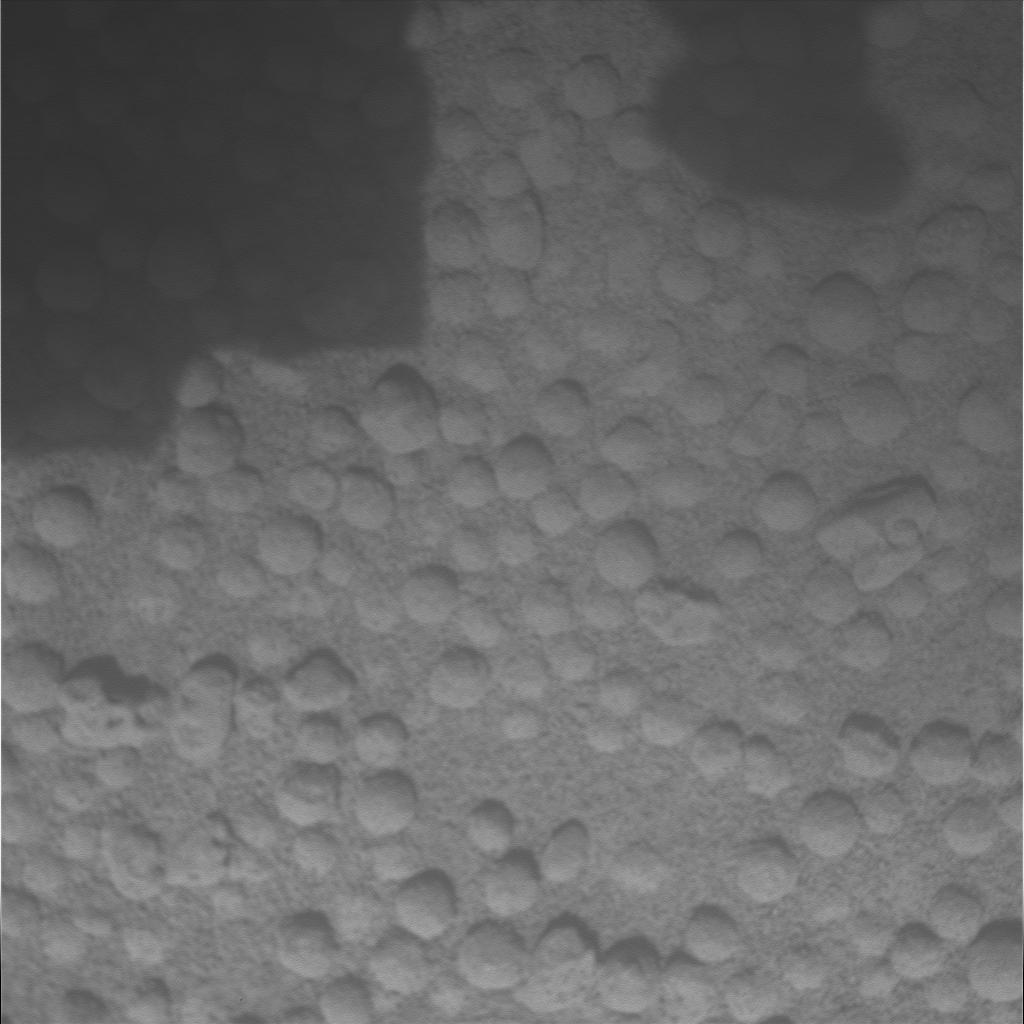
Ocean Watch soil through Microscopic Imager (3cm by 3cm)

Using the microscopic imager Opportunity took a close up picture of the soil before deploying the “IDD” – the “Instrument Deployment Device” – also known as the arm.

Ocean Watch with impression (3cm by 3cm)

Using the microscopic imager Opportunity took another close up picture of the soil AFTER deploying the arm. You can see where the instrument rested in the upper right of the picture. Some of the little bubbles or depressions are flattened, and others have been entirely squished.

Naming on Mars

If you follow the rover missions you’ll have heard of rocks and landforms on Mars named things like “Chocolate Hills,” “Concepcíon,” “Columbia Hills,” “Endurance,” or “Jenny.” Naming of objects in the solar system has to go through the International Astronomical Union (IAU), which can take years. In order to stay sane and not constantly have to say to each other “let’s take a look at that rock” or “shall we drive to crater 001-5BX?” the technicians and scientists working with the Mars rovers assign their own names to these items. Ocean Watch is such a name. I find it likely that many of these names will stick – having been used for years by the time the IAU has time to choose official names – but some will be changed, and some are of locations too small for anyone to care about once the rover has driven on. Ocean Watch is a very small patch of soil (about 1/4 of a square meter), so who knows what will happen.

For now though, a little patch of a distant planet holds a name that reminds us of the fragility of our own planet, and honors the excitement of doing science and science outreach.

Want More?

More information about this soil will eventually be posted in the MER Analyst’s Notebook.

[*Technically I wouldn’t use the word “dirt” because that tends to imply organic content … but, forgive me this time.]()

Thank you, Amy.

~ A l i c e !

. Savransky and J. Bell (Cornell) / JPL / NAS

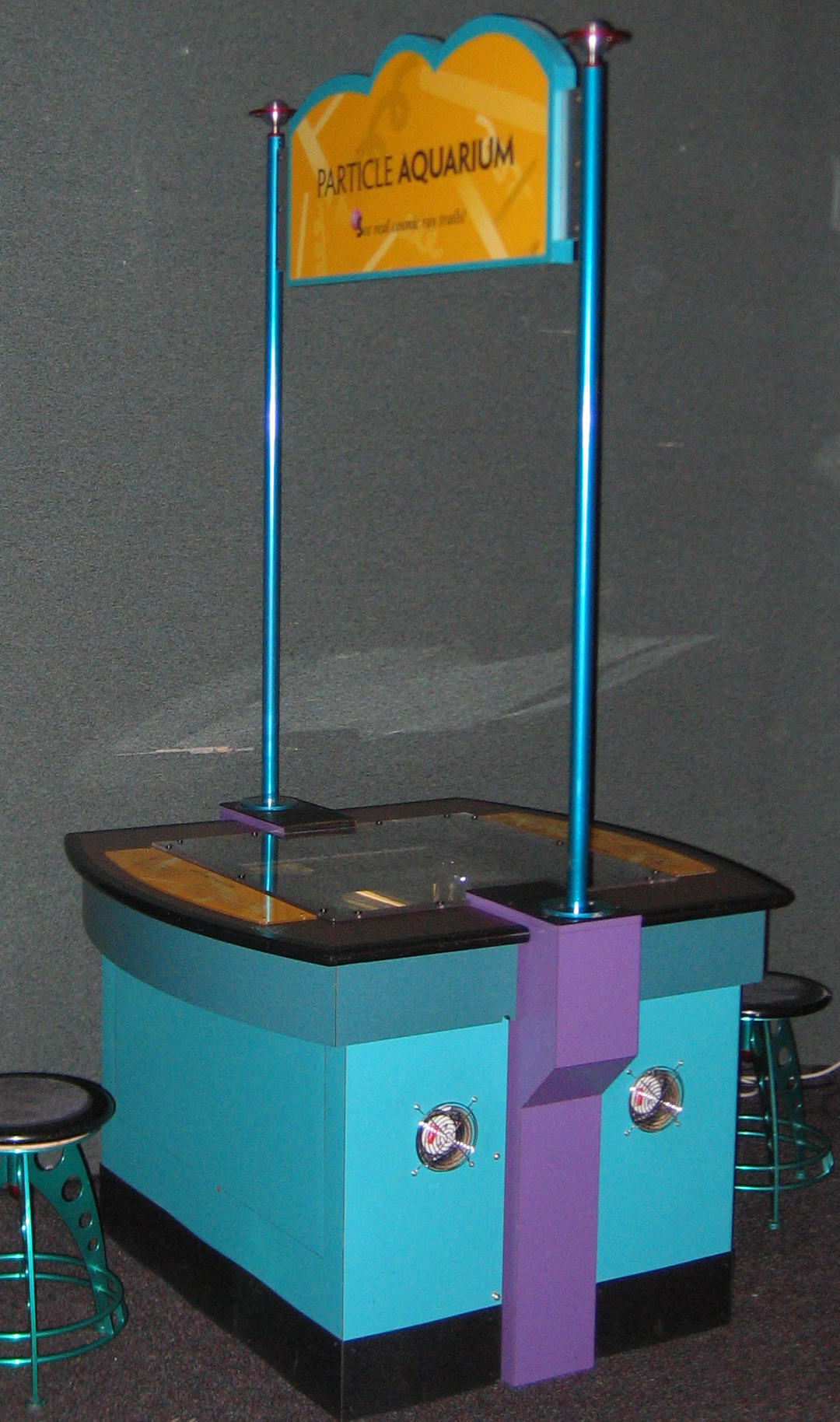
Particle Aquarium

One of the small, unassuming—and much cooler than you might expect—exhibits at Pacific Science Center is the Particle Aquarium, also known as a cloud chamber or cosmic ray aquarium.

In Short

The particle aquarium creates a supersaturated environment of alcohol vapor. Charged particles (from space as cosmic rays or from radioactive decay closer at hand) pass through this supersaturated field. They leave behind a trail of ions, and those ions are nucleation sites, places where the alcohol vapor can condense into liquid droplets, which makes a trail of tiny droplets of alcohol. You see those trails, so you’re seeing the path of a cosmic ray from space.

As many cosmic rays as you see in the chamber, there are more than that there, and just that many are going through your body too at this very moment. You can also identify characteristics of the particle by examining the shape of the path.

How it Works

Look closely.

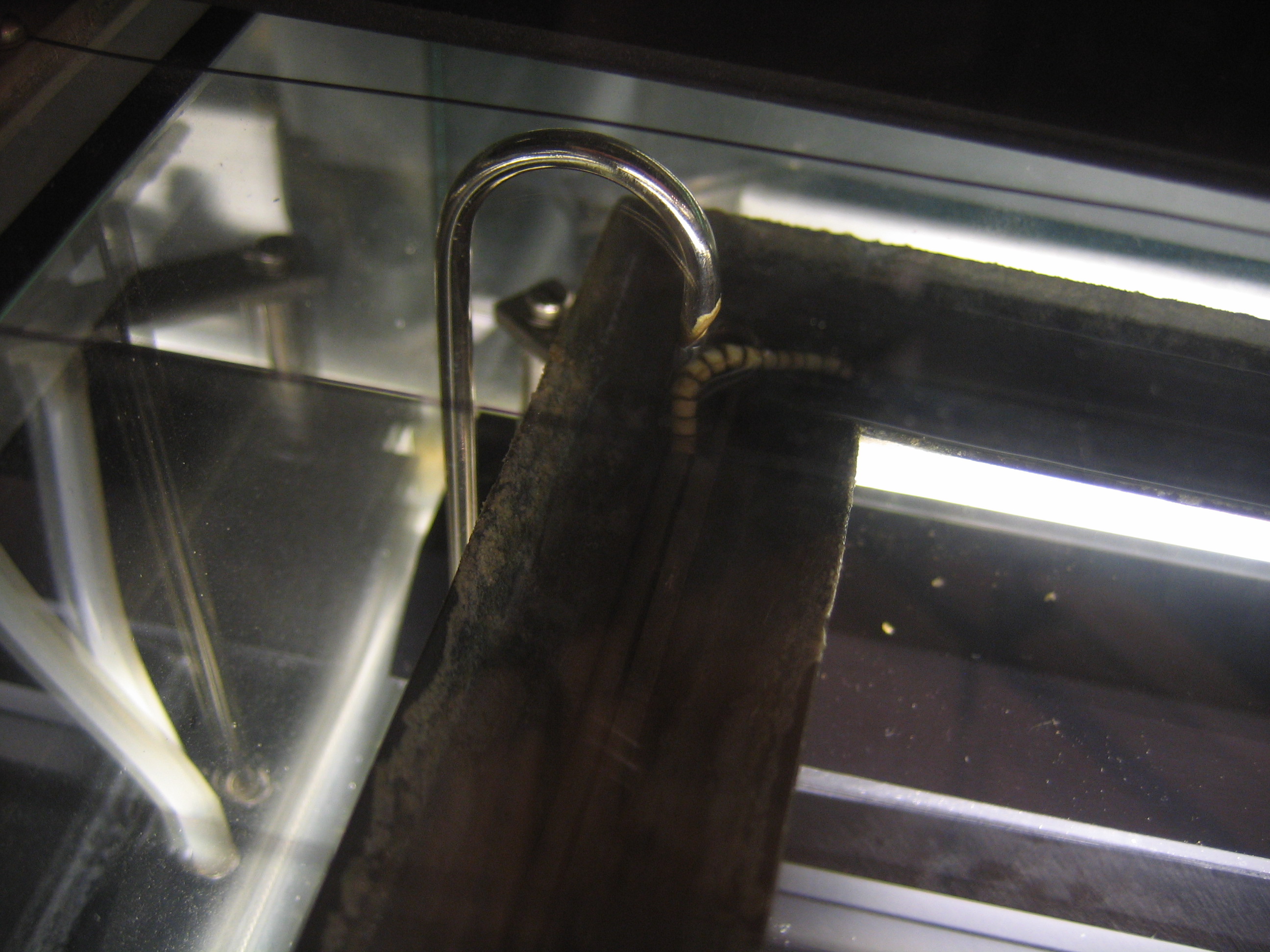
At the top is a place where alcohol is dripped into a small tray that runs around the edge. This is where the alcohol is heated until it evaporates, filling the entire chamber with alcohol vapor. At the bottom of the chamber is a chilled plate. As the vapor falls towards the plate it cools, creating a supersaturated layer of vapor near the bottom of the chamber. This layer is primed and ready to condense, it just needs a little push.

Any kind of push will create condensation in the supersaturated layer. As a charged particle passes through air it leaves a trail of ions in its wake. This is not to say ions are falling off the charged particle—no, it is interacting with the molecules in the air, turning them into ions.

Those ions cause the supersaturated alcohol vapor to condense, which shows the trail of the charged particle. The droplets fall to the cooled plate, and the track disappears.

Charged Particles and Ions

Remember back in chemistry when you learned that an atom has protons and neutrons in the nucleus, and is surrounded by a cloud of electrons? You also learned the protons (positive charge) and electrons (negative charge) tend to be in balance with each other, giving you a neutral atom. Depending on your teacher she might have called this a “happy atom.” Well, knock one of those electrons away—because it’s way more complicated to knock off a proton, we call that fission—and you create a positive ion, or what your teacher might have called an “unhappy atom.” You can do the opposite too—add an electron—and you have a negative ion.

Well, charged particles are, by their very definition, charged. Positive charges and negative charges attract, negative and negative repel, and positive and positive repel. So, if you get a charged particle near a neutral air molecule you could very well affect the outer electrons for that molecule. (And yes, I switched from using atoms to molecules – they work the same way in this case)

Cosmic Rays and Radioactive Decay

There are all kinds of cosmic rays in space (mostly from the Sun) and a good number of those make it down through our atmosphere to us. Not nearly all of them though, our atmosphere protects us. Here are three major types of rays:

  • Alpha radiation is Helium nucleii (Heliums without electrons)—they have a positive charge, and are fairly heavy as particles go.
  • Beta radiation is either electrons or positrons. When they’re electrons they have a negative charge, when positrons they’ll have a positive charge. These are fairly lightweight.
  • Gamma radiation is photons. They’re charge-less and very lightweight.

Watch for

  • Thickness: heavier particles can make thicker lines
  • Speed: faster particles travel straighter
  • Deflection: a ray’s interaction with other particles, electrons, etc will cause deflection
  • Simultaneous events: probably from the same source
  • Cascade events: one ray/particle interacts with something, causing several rays/particles to be released making their own tracks.
  • Wandering: often caused by a low-energy ray making many interactions
  • Curvature: in the presence of a magnetic field, positively charged particles will curve one direction and negatively charged particles will curve the opposite way.

Experiments to Think About

Both of these mean acquiring items which are generally not that safe to carry around unprotected, and sometimes require special licenses to have in your possession.

  • Introduce a strong magnetic field. The path of a charged particle changes in the presence of a magnetic field.
  • Introduce a radioactive source. Radioactive sources create charged particles.

Vocabulary

[Supersaturated]()—when mixing sugar in your tea, you can only dissolve so much. If you heat up your tea you can dissolve more. If you then let your tea cool off, under ideal conditions, the sugar stays dissolved, even though you couldn’t have dissolved that much sugar in cold tea. This is a supersaturated solution – it’s more saturated than you could make it normally. This is why you should either add sugar to your iced tea before you cool it – or you have to add sugar syrup.

[Nucleation site—]()if you then drop a sugar crystal or some such into the cold, supersaturated tea a the sugar will start to come out of solution and grow more sugar crystals on that first one. The first crystal (which can sometimes just be a rough spot, a spoon, a string, or a piece of sand) is the nucleation site. It acts as a nucleus for the new crystals.

[Ion—]()an atom with too many or too few electrons.

Reservations

I need to do more research, there are two major problems with this article. First – I use the words particle and ray almost interchangeably, I should sort that out. Second – I would like to clarify how to identify types of radiation, and the likelihood the rays you’re seeing are from space versus from radioactive elements in the Earth. I’ll keep working on it, but this should definitely get you started on figuring out how awesome the particle aquarium is. Oh, and I want to stick in some pictures.

Want More?

Andy Foland’s Cloud Chamber
Cloud Chambers
More Cloud Chambers
A Great Lesson Plan (College Level)
A Place to Practice Identifing Tracks

~ A l i c e !

Science with a Twist, Astronomy Day, and Carnival of Space

First off Astronaut Greg Johnson will be at this week’s Science with a Twist on Thursday April 15th at Pacific Science Center. The event is also on Facebook. I’ll be there too, holding a brief discussion about false color, and Toni Meyers, director of Hubble 3D will be speaking about the film.

“Science with a Twist will celebrate Hubble 3D. Toni and Greg will circulate during the event and introduce the film and answer questions after the film. Pacific Science Center’s resident NASA Solar System Ambassador, Alice Enevoldsen, will  also lead you through an explanation of astronomical images: What do you see vs. What’s really there? Tickets for staff are only $17 (21 +, ID required)”

Toni Myers is the director and producer of Hubble 3D and one of the few women directors in the history of IMAX filmmaking. Toni has worked on IMAX documentaries since 1971. She has worked on every IMAX space film and has worked directly with over 120 astronauts and cosmonauts in the making of the IMAX space films. She has an extensive background in a variety of films in addition to  IMAX filmmaking .  In addition to documentary projects she has a background in the music world having worked on music projects for the Beatles’ company, Apple; and individual features and videos for John Lennon and Yoko Ono. The IMAX documentaries that Toni has worked on have been among the most successful here at the Science Center including Under the Sea 3D.   For her work on Hubble 3D  the astronauts of the STS-125 crew presented her with the Silver Snoopy Award in recognition of her excellence and

achievements in bringing the space experience to IMAX audiences around the world.

Greg Johnson graduated from West Seattle High School and from the UW  with a degree in aerospace engineering.  He received his Naval Aviator wings in December 1978.  He served as a senior research officer in Office of Naval Research. He has logged over 9500 flying hours in 50 aircraft and has over 500 carrier landings. In 1990, he was accepted as an aerospace engineer and research pilot at NASA . He joined the astronaut program in 1998. He was the pilot the final Space Shuttle mission to the Hubble Space Telescope. On this mission he logged almost 13-days in space—–traveling 5,276,000 miles in 197 Earth orbits at 17,500 miles per hour. And he was an IMAX cinematographer on the mission.

Next, April 24th will be Astronomy Day at Pacific Science Center. Here’s a copy of that e-mail:

Calling all astronomy enthusiasts!

Celebrate the 20th anniversary of the launch of the Hubble Space Telescope at Pacific Science Center on April 24th.

What: Pacific Science Center presents Astronomy Day

When: Saturday, April 24th 10am-6pm

Where: Pacific Science Center

Astronomy Day this year will be in style at Pacific Science Center! With planetarium shows, hands-on exhibits in Facing Mars, facilitated space-themed activities with our onsite Science Interpretation staff, crafts, and the eagerly-anticipated IMAX film Hubble 3D this day of science just won’t end.

IMAX FILMS

Hubble 3D

Showing April 24th at 10:30am & 11:45am

The perfect way to celebrate the 20th Anniversary of the launch of the Hubble Space Telescope is to take in a screening of this new IMAX film which is gaining rave reviews! Today’s Seattle Times review calls Hubble 3D an “extraordinary spectacle” and an “out of this world documentary.” http://seattletimes.nwsource.com/html/movies/2011381515_mr19hubble.html

Roving Mars

Showing April 24th at 11:30am, 1:30pm, 3:30pm and 5:30pm

Go behind the scenes with NASA scientists and engineers as they worked to design Mars Rovers, Spirit and Opportunity, to travel millions of miles to Mars and report back!

FEATURED EXHIBIT

Facing Mars

Open 10am-6pm

Here’s your chance to experience the sensations, emotions and conditions of a real trip to Mars without ever leaving Earth! Build your own simple rocket, take a “Mars Walk,” see firsthand what microgravity does to the human body and so much more!

Last, you should go look at Carnival of Space #149!

Okay, enough advertising. I’ll tell you more science-y stuff next week.

~ A l i c e !

Earth-Centered Events

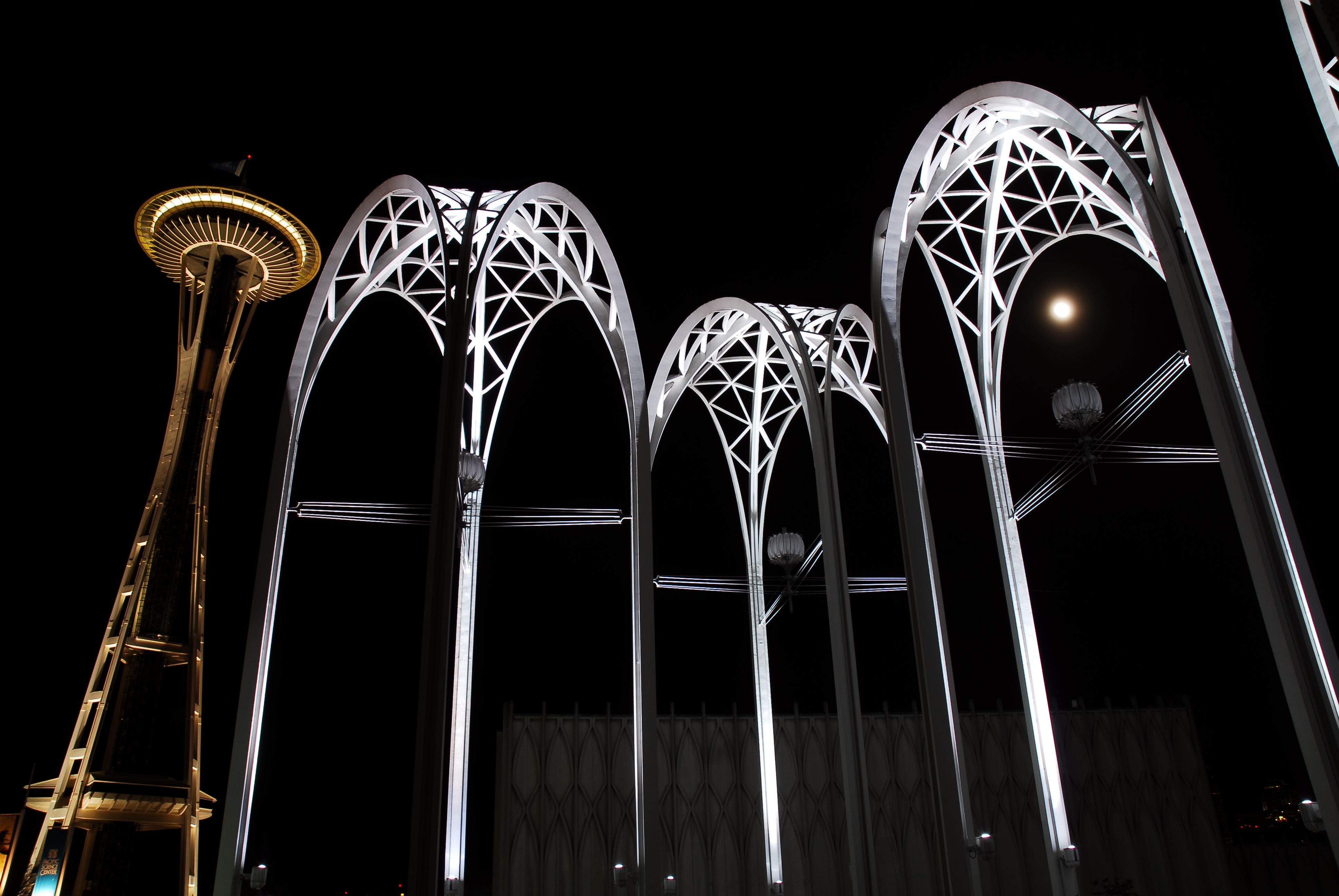
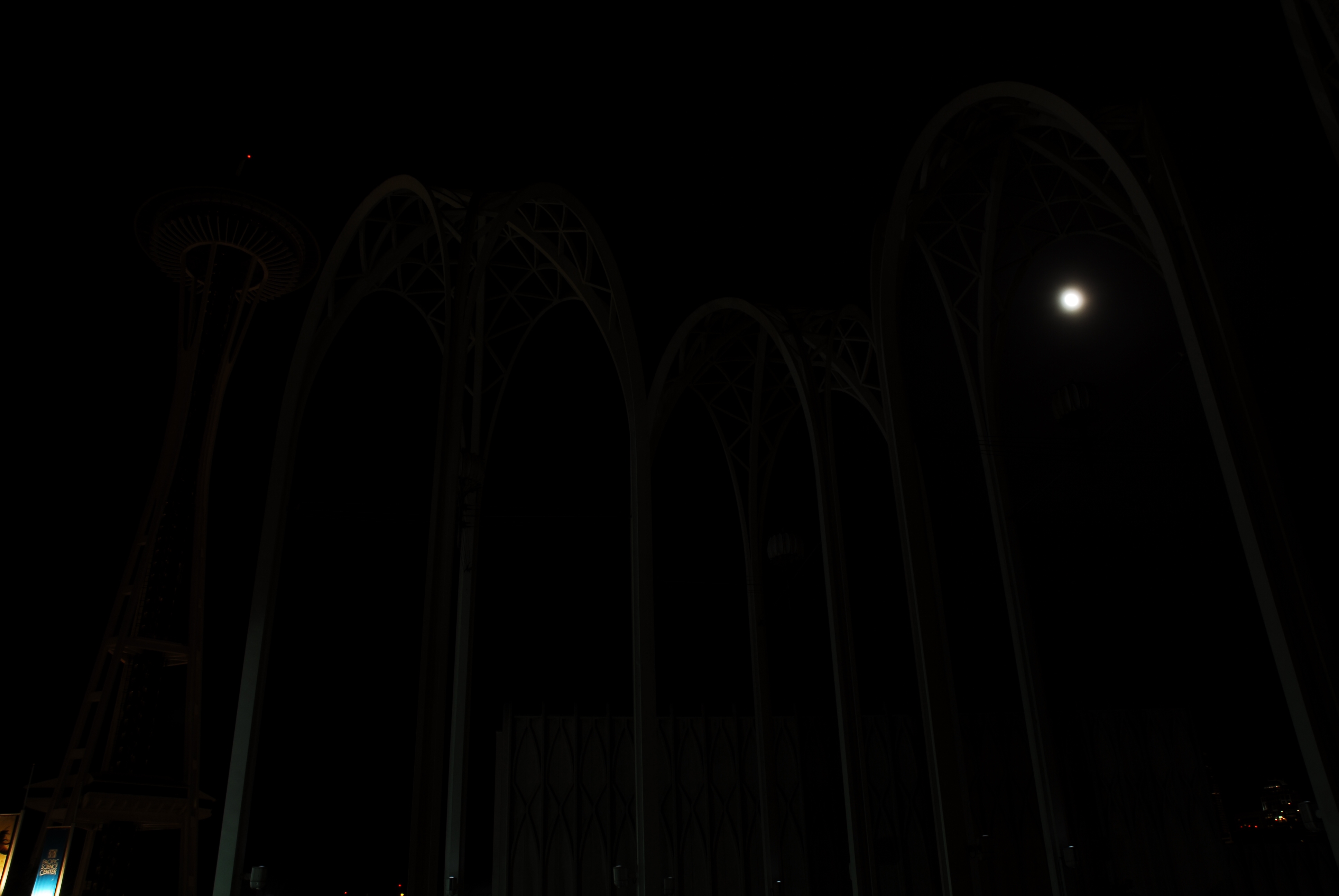
Today is “just” some photos for you of the Earth-Centered events that have happened over the last week. First, Earth Hour just finished here in Seattle – so a pretty before-and-after of Pacific Science Center and the Space Needle. (Click to get the full-resolution versions).

Pacific Science Center before Earth Hour 2010 Photo: (C) Jason Ayres Gift Enevoldsen

Pacific Science Center during Earth Hour 2010 Photo: (C) Jason Ayres Gift Enevoldsen

Equinox Sunset

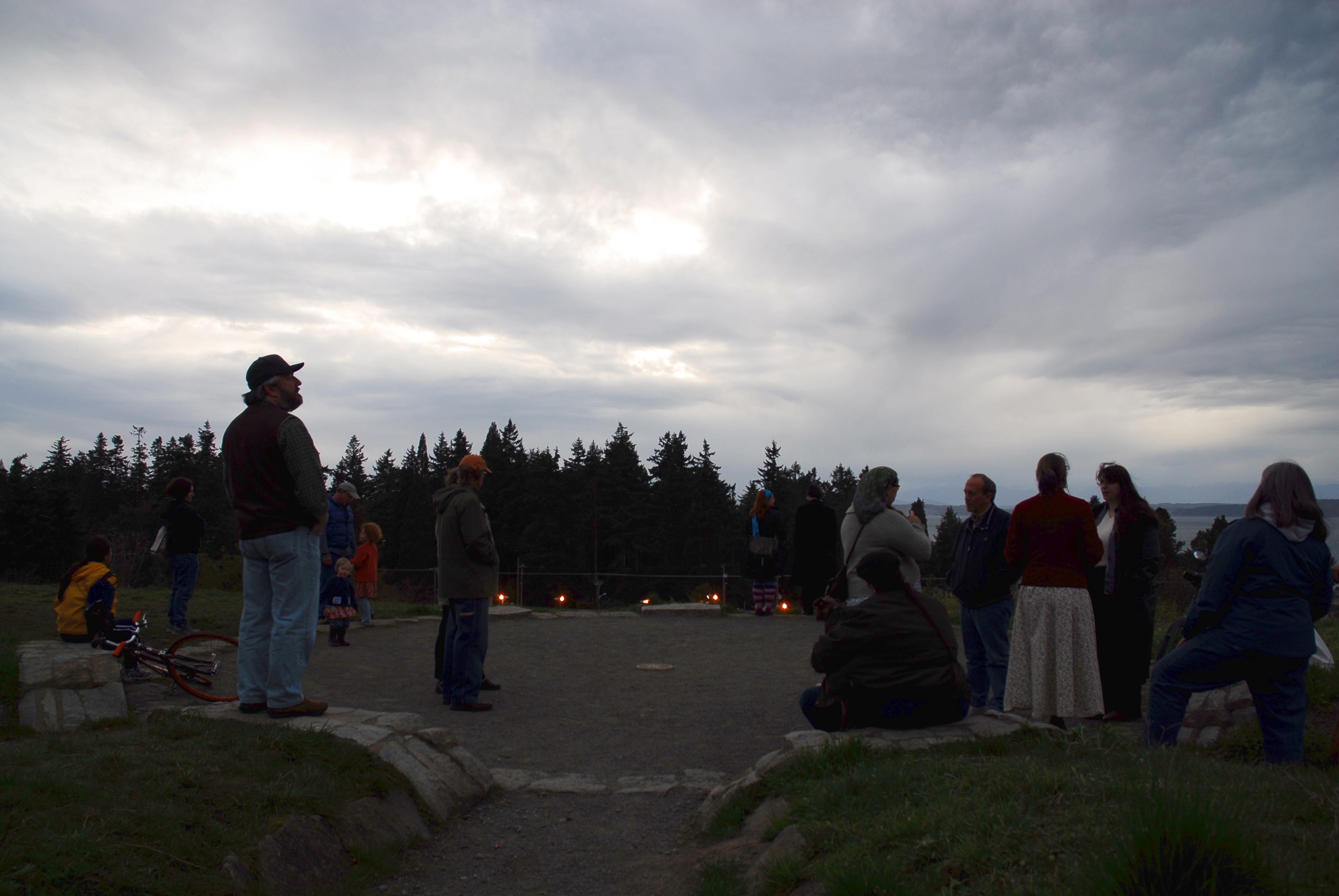
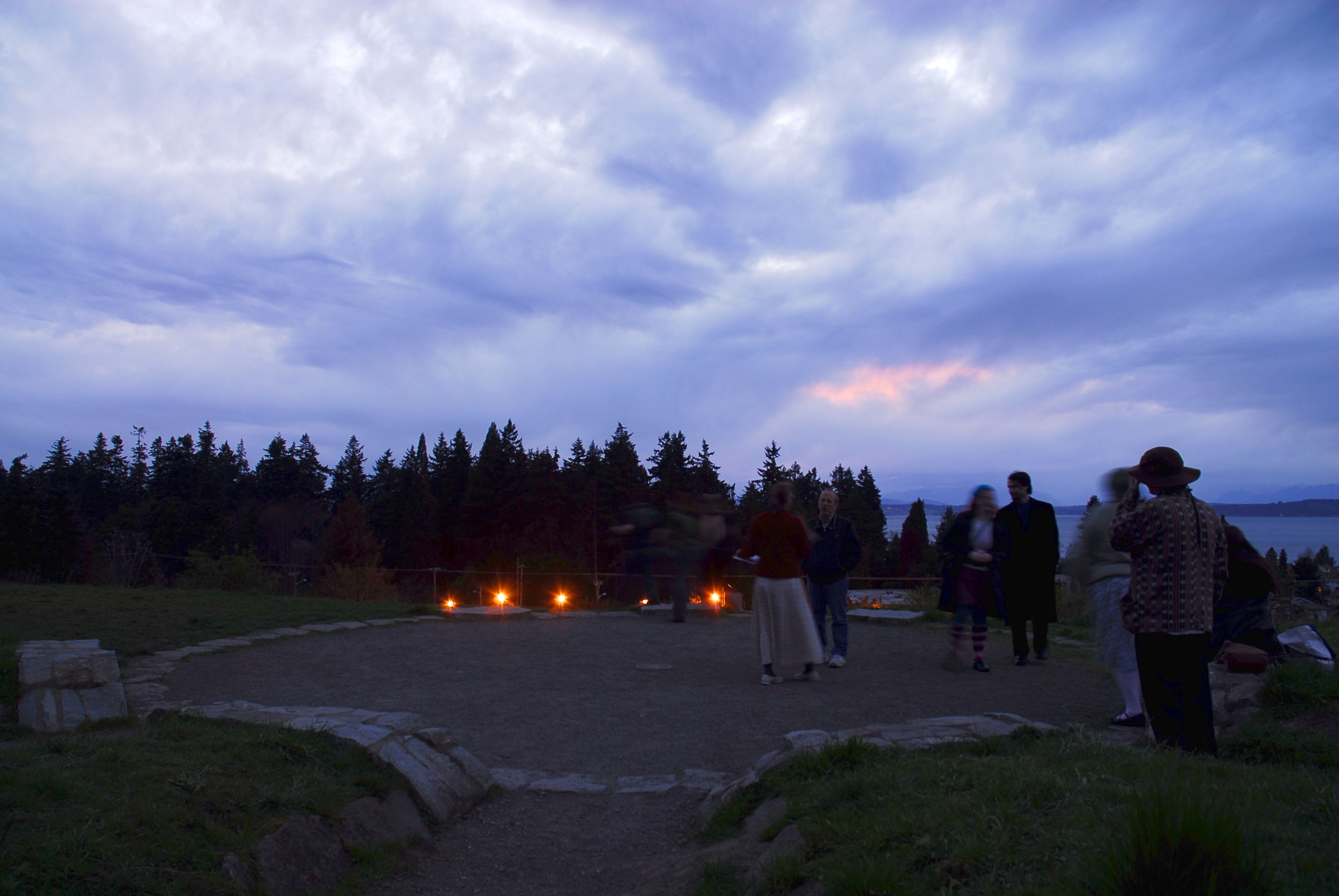
I haven’t had a chance to tell you how fun the West Seattle 2010 Spring Equinox Sunset Viewing at Solstice Park was. Unfortunately, we didn’t see the Sun … remember, this is Seattle. If you schedule a sun-dependent event, it will be cloudy. Anyway, we had 30-40 folks show up, and had a good time anyway. Greg posted a nice piece over at the Seattle Astronomy Examiner about it. (Click pictures to see high-res)

STILL waiting for the Sun. Photo Credit: Jason Ayres Gift Enevoldsen

Waiting for the Sun - Photo Credit: Jason Ayres Gift Enevoldsen

STILL waiting for the Sun to set - Photo Credit: Jason Ayres Gift Enevoldsen

Talking with the crowd while we wait. Photo Credit - Greg Scheiderer

~ A l i c e !
Hubble 3D vs Life

I went to see the press preview of  Hubble 3D at Pacific Science Center’s Boeing IMAX Theater. It’s opening on March 19th (2010) – tickets here. Full disclosure, in case you were unaware, I am employed by Pacific Science Center but my comments here are my own.

I have been looking forward to this film for months, and I was struck by the similarity to some of what I do. So, if you will excuse the conceit, I would like to share a double story with you.

Hubble

Hubble 3D is partially just plain fun: fly-throughs of actual beautiful Hubble images, three-dimensionalized by some very talented folks who worked with some very intelligent astronomers to be as accurate as possible. As much as I love Hubble images, the other part of the movie is what I enjoyed most. The story of how to fix an ailing telescope, 350 miles above the Earth’s surface. I’ll give you some hints – but go see the movie for yourself to get the full story of the repairs to Hubble.

A Day in the Life

Then there’s what I do. In November, the planetarium projector also chose to show its age. On its way down the elevator shaft it slipped the last six inches and refused to budge. This was extremely scary for all of us, and after several calls to the techs in Pennsylvania we decided we needed to winch it up.

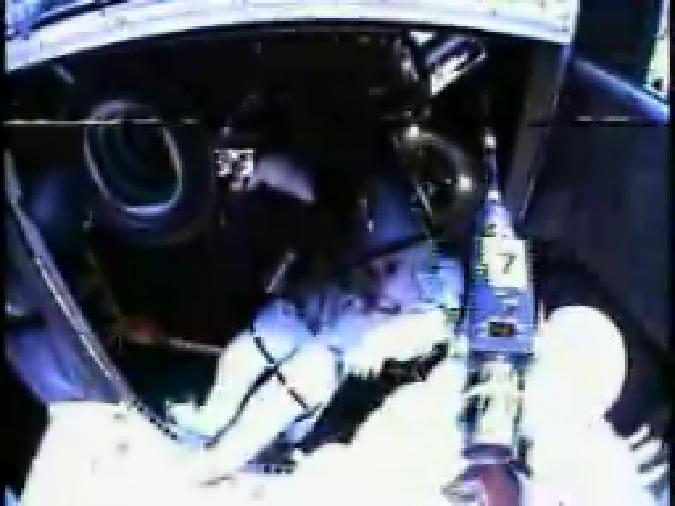
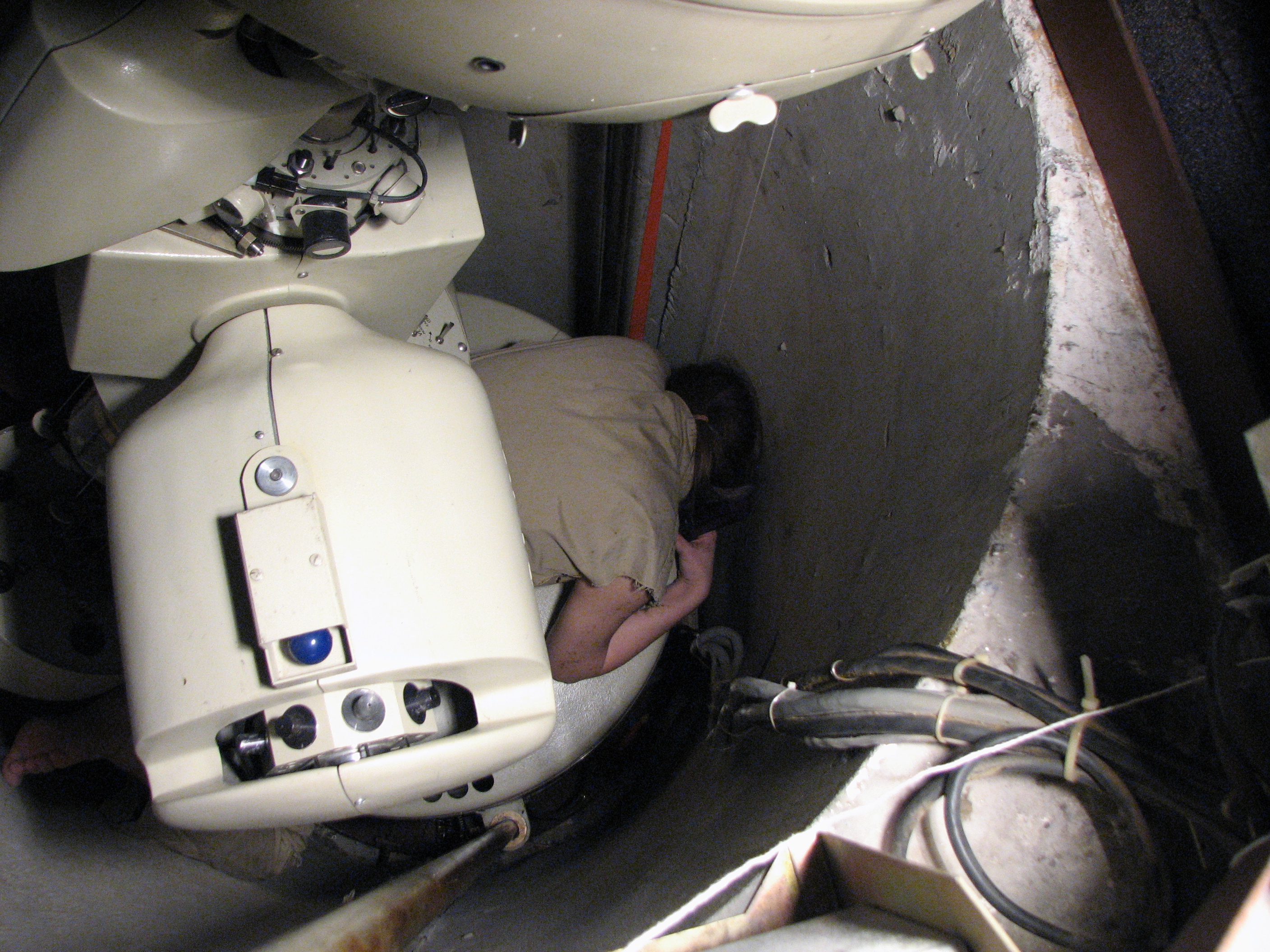
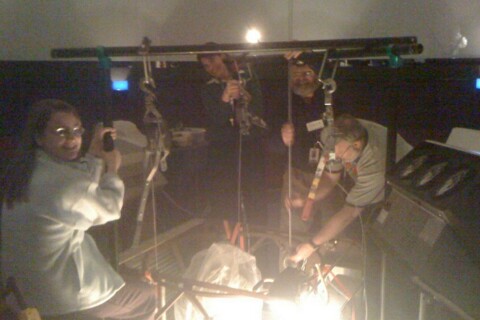
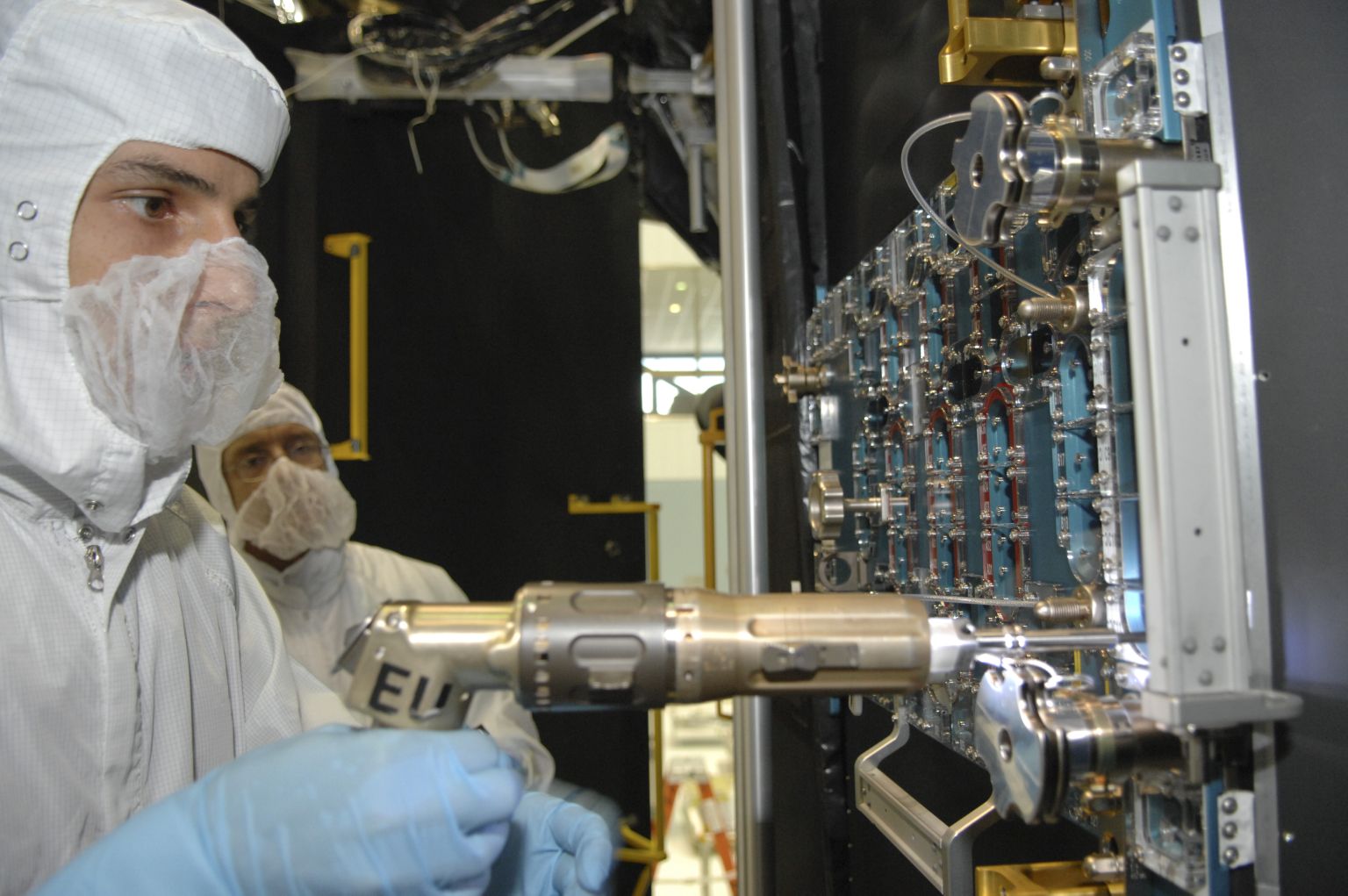
Here’s where it gets similar to the Hubble mission. Compare these two pictures:


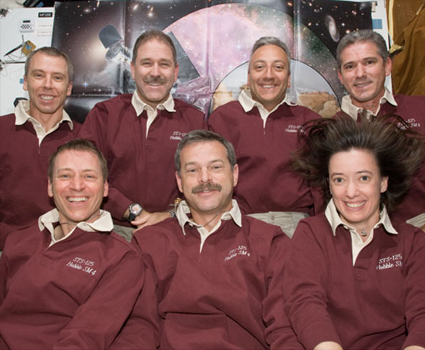
That’s Astronaut Mike Massimino in the center, with his head stuck up in the bowels of Hubble. Astronaut Mike Good’s  hands are in the lower right, holding a tool that looks like a drill with a long bit.
And this is me. Five feet down an elevator shaft that’s about  three-and-a-half or four feet in diameter, trying to reach down another two and a half feet to unhook a chain.

The astronauts on STS-125 had quite a lot more to contend with, they were wearing space suits, the stakes were higher, their equipment larger and more expensive, but we both succeeded through teamwork, specialized tools, perseverance, and time.

Nemeses

Ah, and then the equipment just seemed to fight back:


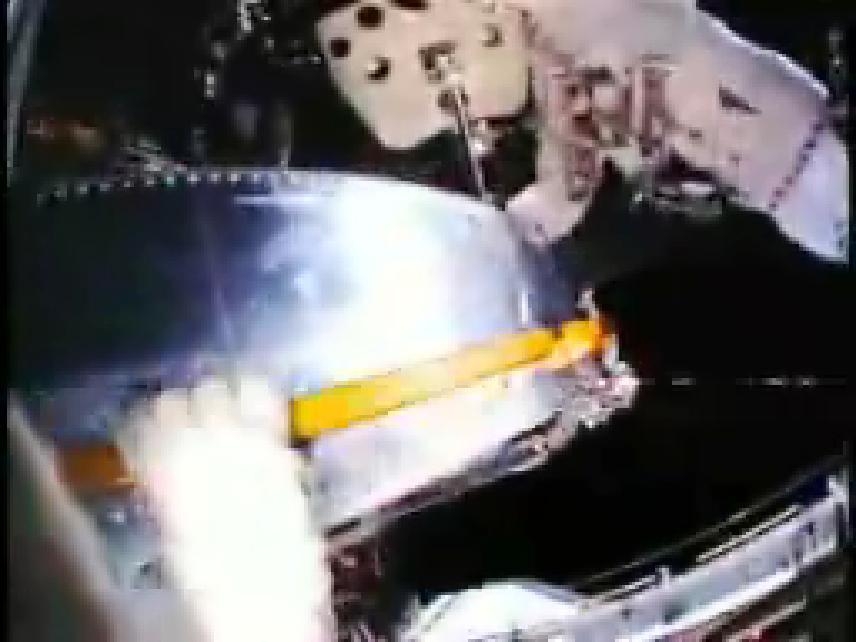
This is not the handrail that Astronaut Mike Massimino had to break off, but it looks very similar and I can’t find a photo online of the broken one.


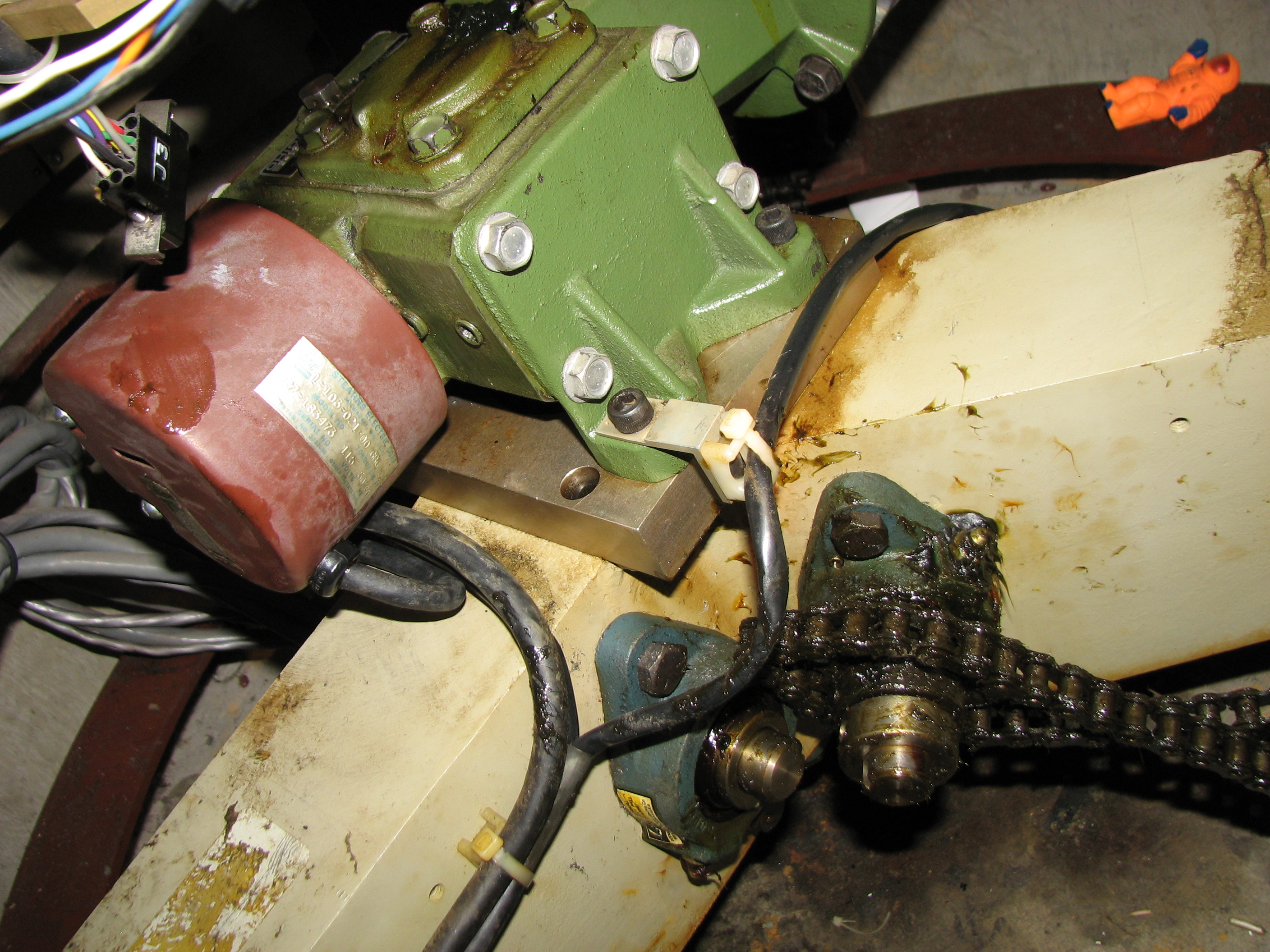
This chain and sprocket caused a day and a half of work for several people. Arrrgh! But, we succeeded!

Specialized Tools


In order to safely remove small screws in space, and be able to manipulate power tools while wearing gloves, they developed some very specialized tools for the Hubble repair missions.
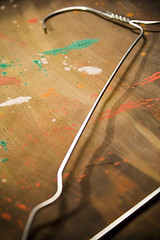
Well, we were inspired by this – but  Mark made a tool very similar, but with a slightly pointier point. Unfortunately, that tool is at the bottom of the elevator shaft now, so I can’t show you a real picture.


(Coat Hanger credit: Demion on Flickr)

Teamwork


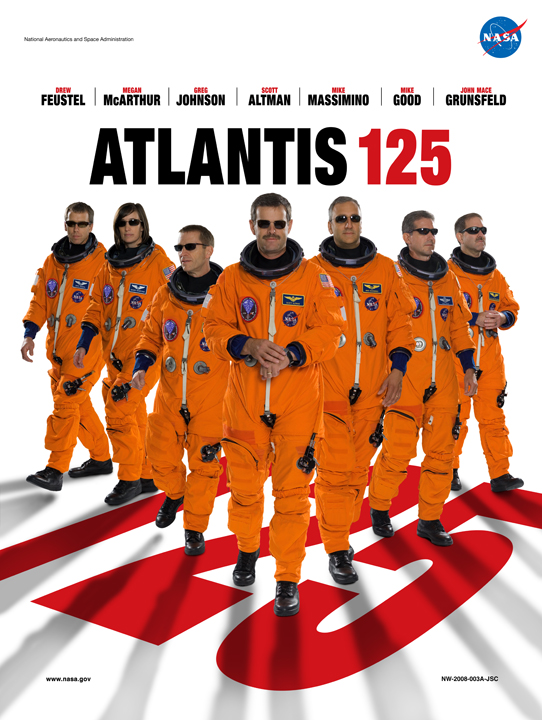
This is the team, and this is their poster:
I love it.
Well, we may not have a movie poster, but we couldn’t have lifted the projector without the work of a large number of people, not the least of whom were Mark Rogers, Kim Chinn, Sarah Huschle, Chuck Hanna-Myrick, and the planetarians!


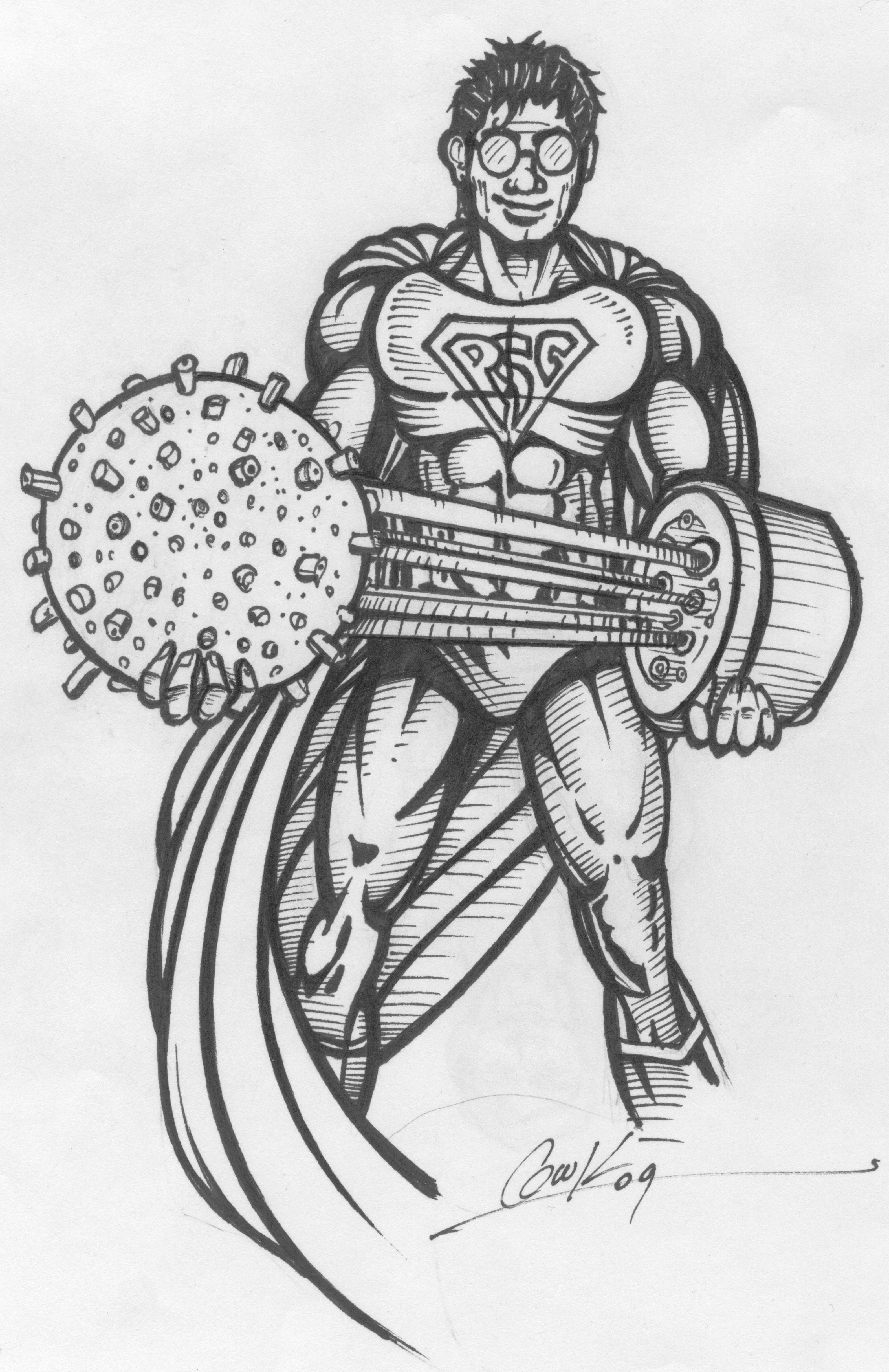
Gary Kezele made the commemorative sketch.

Want More?

Hubble

STS-125 (the repair mission)

Hubble 3D in IMAX – the newest IMAX space movie.

See it in Seattle (Use this link until March 19th) (Use this link after March 19th)

~ A l i c e !
P.S. All astronaut photos are from NASA. As you might expect.

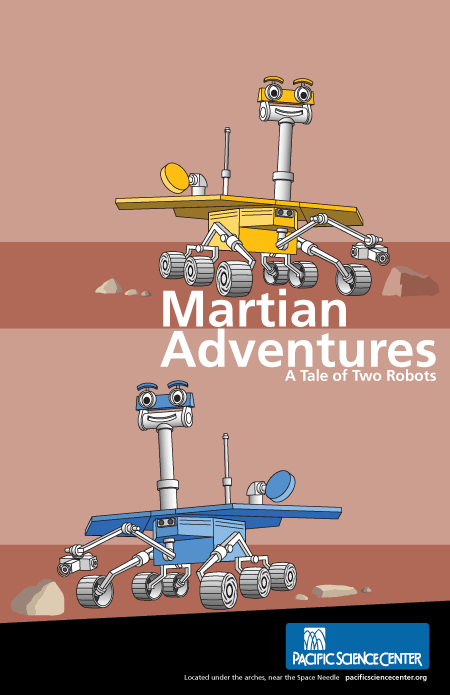
Martian Adventures: A Tale of Two Robots

Opening today!

To go along with Pacific Science Center’s Facing Mars exhibit and Roving Mars IMAX film, we’ve created a new planetarium show.

Come hear stories about the adventures of NASA’s Mars Rovers, Spirit and Opportunity. Make your own decisions regarding some of the challenges they’ve faced and learn to find Mars in tonight’s sky. View photos of the Martian surface that are less than a week old, and root for the rovers to keep on roving! Ticket required (FREE tickets for Pacific Science Center members!) 40 minutes – ages 4 and up. Children under 4 are not admitted.

Go to pacificsciencecenter.org for plenty more information about the exhibit and both shows.

RSVP to our Facebook event, and show your support!

When is it Showing?

<iframe src="https://www.google.com/calendar/embed?title=Planetarium%2FLive%20Science%20Schedule&showTabs=0&showCalendars=0&mode=AGENDA&height=450&wkst=1&bgcolor=%23FFFFFF&src=dcle5i4ol982f5t7vmotmn3ito%40group.calendar.google.com&color=%2388880E&ctz=America%2FLos_Angeles" style="border-width:0" width="450" height="350" frameborder="0" scrolling="no"></iframe>

Some further notes on the show:

Since we wanted a show to complement Facing Mars, I tried to write a show that encompassed the experience of the journey to Mars and what you might face while there – just as the exhibit does. Unfortunately, we have not yet sent people to Mars so I decided to focus on the two robots, Spirit and Opportunity, who seem to have captured the hearts and imaginations of people all over the world. Somehow Spirit and Opportunity (or “Oppy” as we call her) have become beloved pets through whom we can visit a small portion of this alien world.

We were also trying to avoid just another “Red Planet” show, a show listing the most commonly-known facts about Mars: it’s red, it’s got the largest volcano in the solar system, it has the largest valley in the solar system, it has seasonal dust storms, etc. Even if you didn’t already know those facts, you’ll find them in almost any book, TV show, or movie about Mars. We wanted our show to be different.

I also recently attended a storytelling workshop with Jay O’Callahan, who wrote the incredibly moving story of NASA’s first 50 years, “Forged in the Stars”. Good storytelling transports us into the story, and Jay is a master at that. I was inspired by the workshop to begin writing “fact-tales” as my co-worker Michael Bowers calls them; thus “Martian Adventures: A Tale of Two Robots” was born. I cannot claim to be anything like the master that Jay O’Callahan is, but the planetarium staff have taken the stories I outlined and turned them into exciting adventure stories, weaving their words so you hope along with mission control that the rovers will persevere.

The show isn’t all fact-tales though, this is Pacific SCIENCE Center, and “interactive” is one of our watchwords. During a portion of the show guests get to conduct their own analysis of the surface of Mars. We update the show every week with the very newest pictures from the rovers, pictures so new there aren’t usually press releases from the scientists explaining them. So, you get to be the scientist. The planetarians will lead you through the photos asking you to make scientific observations and put forth your own hypotheses about what you see in the pictures. A warning about this for people who need to know “the” answer: the planetarian will not be able to tell you what the best answer is. As I said above, the scientists haven’t had a chance to release their findings about these pictures. That’s what I love about this portion, if you want an answer you have to think of one that matches all the clues you see, you have to be a scientist. You can always check NASA’s website in a few weeks and see what conclusions the scientists have come up with.

I intended this show to appeal to young and old alike, but the story sections might be a little long for children under six or seven. Also, as usual, children under four are only admitted to Preschool All-Stars – our short show expecially for preschoolers and their families. I recommend Martian Adventures: A Tale of Two Robots for anyone who likes discovering and stories.

Oh, and of course we show you where to find Mars in tonight’s sky!

~ A l i c e !
Dunes on Mars – New HiRISE Images

Oh the beauty that can result in faraway places untouched by human interference:

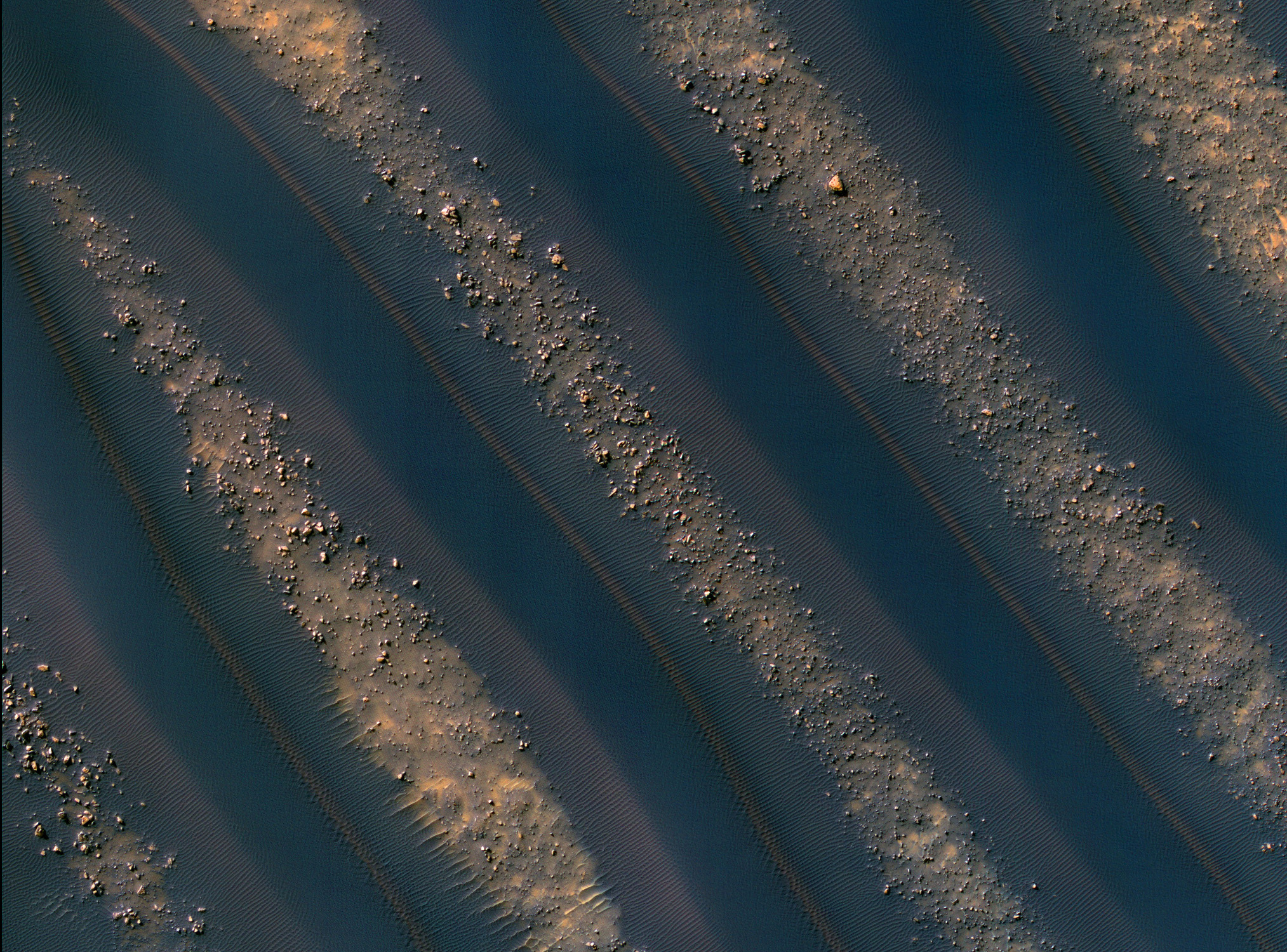
Dunes from a crater in Noachis Terra, west of the giant Hellas impact basin. Image credit: NASA/JPL-Caltech/University of Arizona

I’m getting so excited about Facing Mars coming up at Pacific Science Center. Just a little over one week to go! So, to keep myself entertained, I’ve been looking at some new Mars stuff.

The 10-Second Summary (What you need to know)

  • First, click to make that picture bigger. You’ll be amazed at the detail. The boulders are in between the dunes.
  • Second, dunes are common on Mars, being a planet covered in dust and sand.
  • Third, Mars Orbiter (home of the HiRISE instrument) was not functioning for a while there, but it started working again – and this picture is one of the new ones (from late December 2009). HiRISE is a camera that takes some of the most detailed and breathtaking images we’ve ever seen. It can see the rovers’ tracks from orbit – it is that good.

About Dunes

There are a few basic types of dunes, and they all depend on the angle and changeability of the angle of the wind, the surrounding landscape (are there trees? mountains? bushes?), and the size of the particles that make up the dune.

Longitudinal Dunes

Longitudinal dunes tend to form parallel to the primary wind direction. The picture above from HiRISE is a perfect example of longitudinal dunes.

Star Dunes

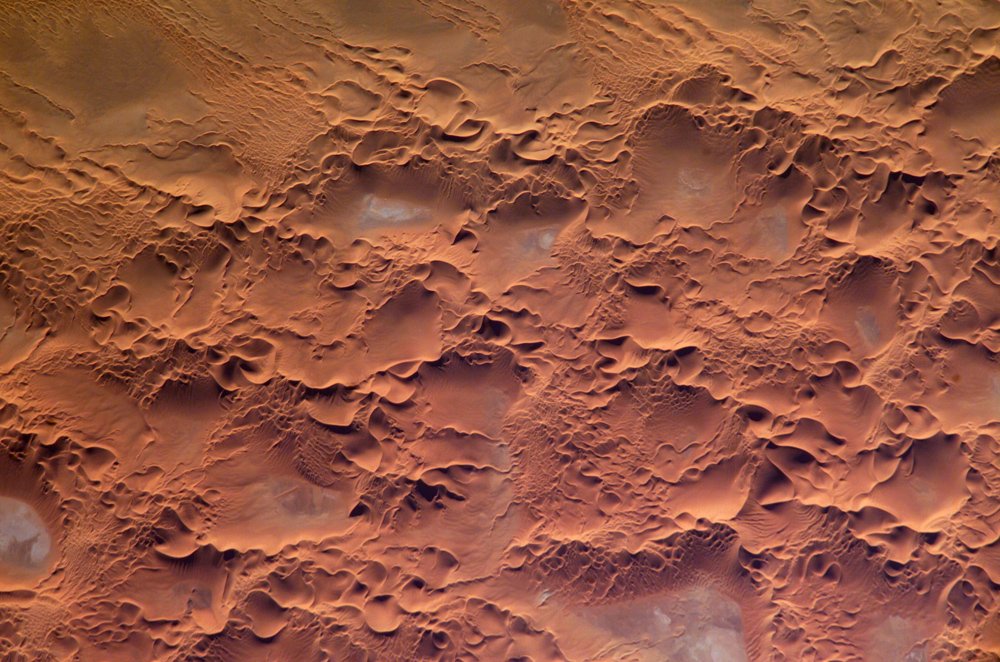
Star Dunes - Issaouane Erg, Algeria from NASA

Star dunes occur in areas with widely shifting wind directions.

Parabolic Dunes

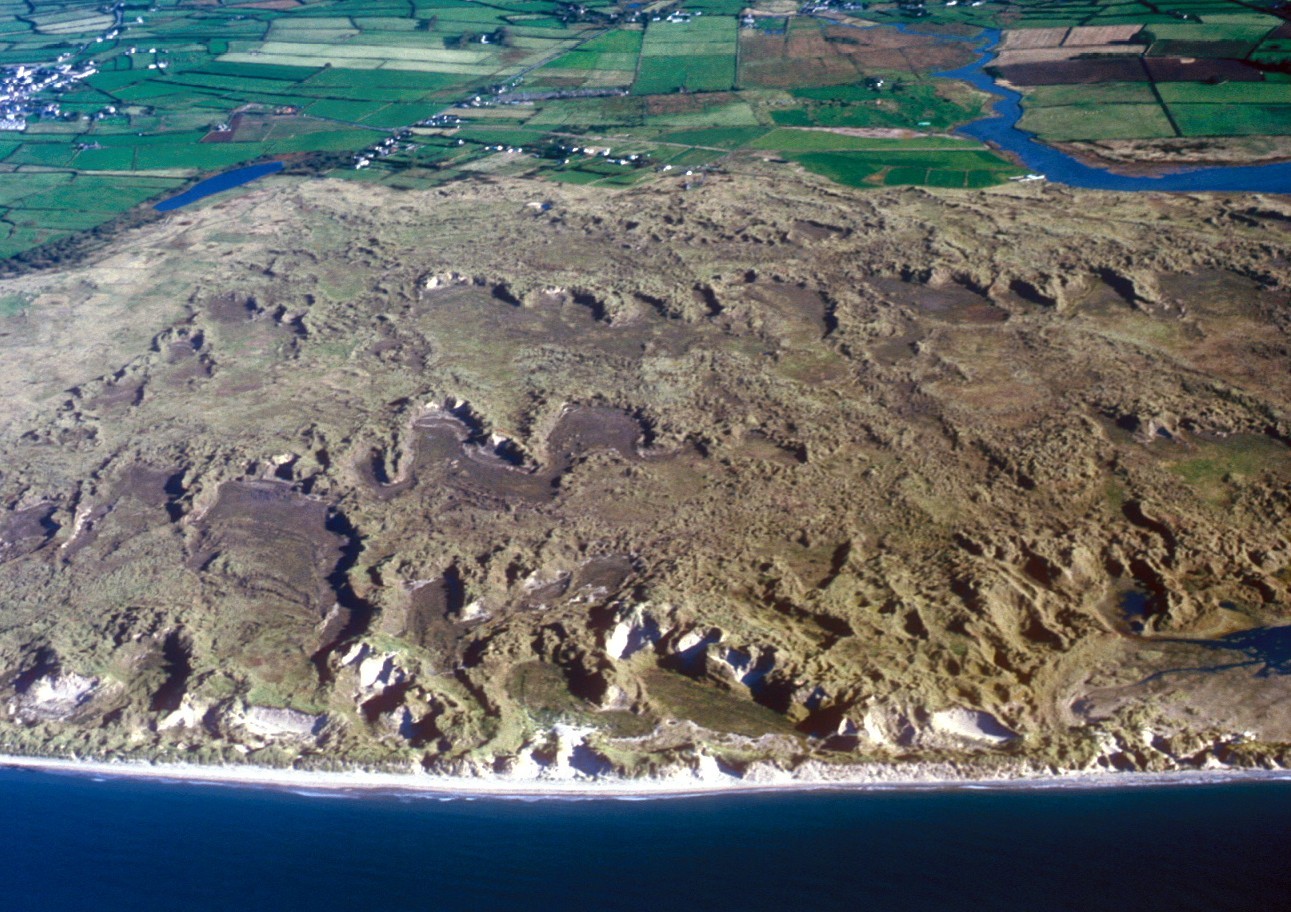
Parabolic Sand Dunes - thanks to Newborough Warren

Parabolic dunes occur in an area where the wind direction is constant, and their open side faces into the wind.

Crescent (Barchan) Dunes

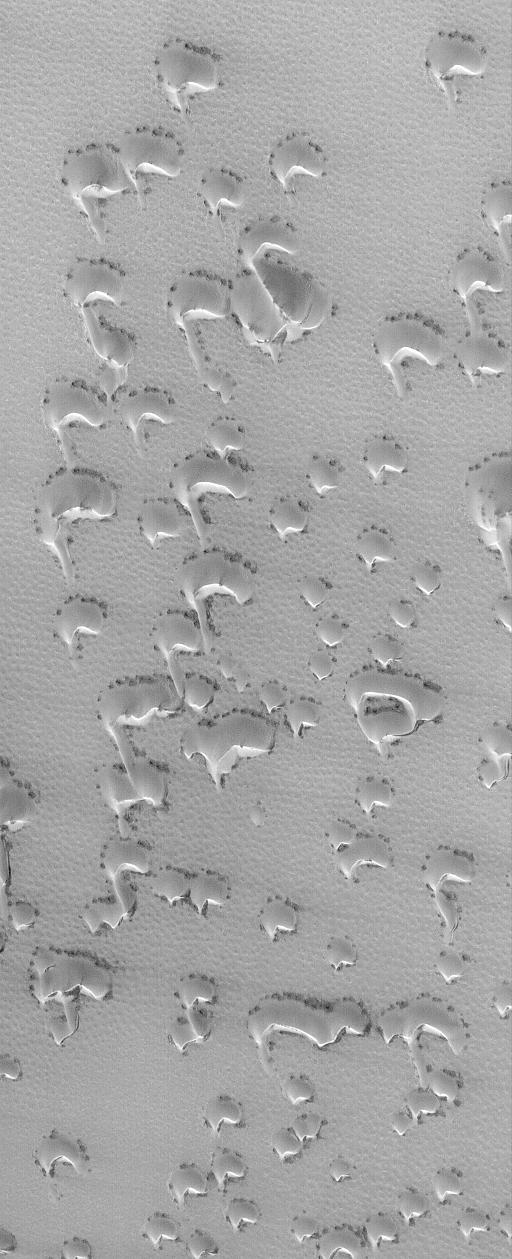
Crescent (Barchan) Dunes - NASA/Malin Space Science Systems

Crescent or barchan dunes occur in an area where the wind direction is constant, and their open side faces away from the wind. They are very easy to confuse with parabolic dunes.

Transverse Dunes

Transverse Dunes - Astronaut Photography of Earth

Transverse Dunes are very similar to Longitudinal Dunes – except that they form perpendicular to the wind, not parallel. You’ve seen “dunes” like this – the waves in the sand are created by the water in the same way the wind creates these larger transverse dunes.

Want More?

The Mars Orbiter HiRISE Press Release (more detailed info on the above picture itself)

Dunes

~ A l i c e !